Project Story
Finding out whether a search traffic drop was the website or AI search
When a packaging manufacturer's Google clicks fell by about half, we checked the code, Search Console and Google Analytics to find out why. Rankings had improved and impressions dipped by about a fifth, so the lost clicks pointed at AI answers. The page covers the diagnosis and the headless WordPress and Next.js site we built for them.
- Client
- Paramount Global (packaging)
- Industry
- Packaging manufacturing
- When
- 2021 to 2026
- Status
- Ongoing SEO and AI search retainer
- Next.js
- Headless WordPress
- TypeScript
- Tailwind CSS
- Google Search Console
- Google Analytics 4
- Ahrefs
The numbers everyone was looking at
First, the name. This Paramount Global is the packaging manufacturer at paramountglobal.com. It has nothing to do with the film studio.
On July 21, 2026, Paramount’s marketing team flagged their Power BI report, which is fed from Google Analytics. In 2025 the site had been doing around 10,000 users a month and growing. In 2026 the line kept tapering, and visits to the thank-you page that follows a form submission had dropped from around 50 a month to single digits.
That’s the kind of chart that starts a conversation about a redesign, or about whether the agency broke something. Fair question, since we’d been running the site for years by then. We sent our findings back the same evening.
What we checked, in order
We started with the site code, to rule out anything on our side that could hurt search. The site was healthy and still fully indexed.
Then Google Search Console’s Performance report, filtered to web search, comparing the last three months with the same three months a year earlier.
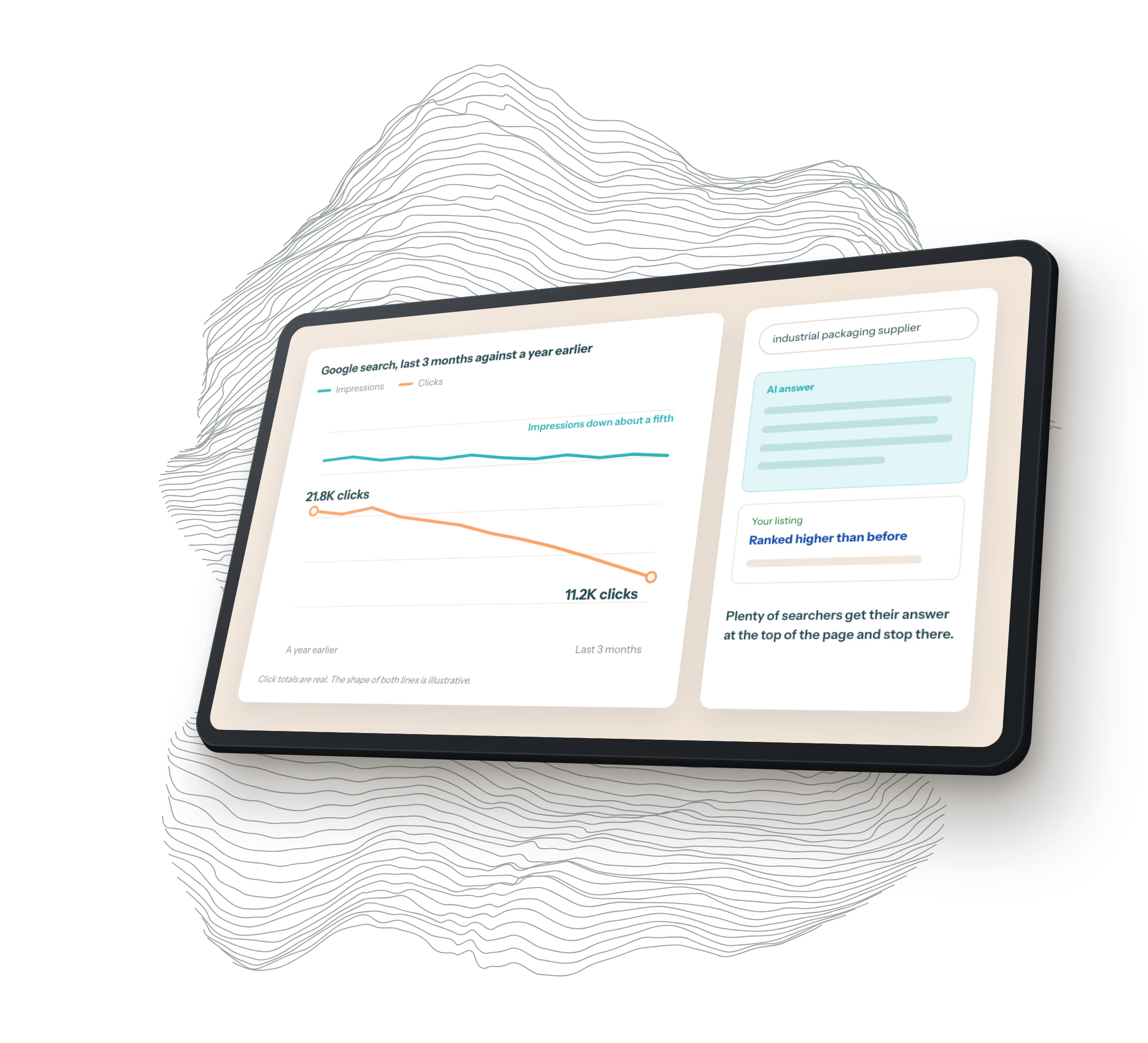
- Clicks went from about 21,800 to about 11,200.
- Impressions, how often Google showed a Paramount page, went from about 3.41 million to 2.71 million.
- Click-through rate fell from 0.6% to 0.4%.
- Average position improved from 24.8 to 13.3.
Impressions fell by about a fifth and clicks by about half. When a site breaks in a way Google notices, rankings usually go first and impressions follow. Here the ranking got better and the click rate is what fell.
To be fair to the other reading, average position is an average over whatever Google chose to show, so part of that jump can come from low-ranking impressions dropping out of the mix. Even read cautiously, nothing in it looks like a site losing ground with Google.
Last, Google Analytics 4. Over the last 90 days against the 90 before, active users were down 28.9% and pageviews 22.2%, while key events (the conversions the property counts) were up 21.1%.
Where the clicks went
Over the same year Google started answering many searches right on the results page with AI answer boxes, and more buyers began doing early research in tools like ChatGPT. Someone who gets the answer at the top of the page doesn’t need to click, so a site can hold or improve its ranking and still lose the visit. A click rate that drops by a third while position improves is what that looks like in Search Console.
There was a good sign in the same data. Direct and brand traffic, people who already know Paramount and come straight to the site, grew over that year, and those visitors were still filling out forms. The part shrinking was people finding Paramount for the first time through a Google search.
The thank-you page didn’t fit, since it had fallen further than traffic alone explains, so we flagged the contact form flow for its own check. Paramount’s team then found their form submissions didn’t match what Power BI was reporting, and took the gap to their IT team as a reporting problem.
To be clear, we can’t prove every lost click went to an AI answer. Google doesn’t report that. What we could show is that the site was working, so a rebuild wouldn’t have fixed it.
How the site is built
We’ve built and maintained Paramount’s site since 2021, which made the code check quick. In late 2024 we moved its content off Contentful to headless WordPress, in a run of pull requests from November to December. Headless means the marketing team edits products, industries, services, articles and the glossary in the WordPress admin, while the public site is a separate front end that reads that content.
The front end is Next.js 15 on the Pages Router, in strict TypeScript since a migration in April 2026, with Tailwind CSS, hosted on Vercel behind Cloudflare DNS. It reads WordPress through its GraphQL API, and every page is generated at build time with getStaticProps for both editions. When an editor publishes, a WordPress plugin we wrote adds a button to the admin bar that starts a new Vercel build.
A few build decisions came from things going wrong once:
- The GraphQL client retries a failed or rate-limited request after 2, 4 and 8 seconds, about 14 seconds in all, enough for WordPress to come back from a short restart. If it still fails, the build stops instead of publishing pages without their content.
- Redirects live in WordPress and are pulled into
next.configat build time, so the marketing team can fix an old link without a developer. The migration generated the redirects from the old Contentful URLs. - Content from WordPress is sanitized with DOMPurify before it’s rendered.
- The product catalog used to fetch its results from the visitor’s browser, so the HTML search engines received had no product links. In October 2026 we moved it to build time, with search and filters running in memory, and the served HTML now carries the links.
We also wrote small WordPress plugins for the team: draft previews of unpublished pages, a “bump to top” control that moves a refreshed article up the blog without changing its publish date, and toolbar buttons that drop a styled call-to-action button or a key takeaways box into an article.
US and UK editions, and the structured data
The site runs as a US edition at the root and a UK edition under /uk/. Some products only exist in one country. Each page emits a canonical tag plus hreflang annotations (en-us, en-gb and x-default) that tell Google which version to show where. In August 2026 we found UK-only pages were pointing en-us and x-default at US addresses that didn’t exist, which makes search engines throw out the whole group. We counted 114 such pages among the 2,090 URLs in the sitemap and fixed the component so every page references itself and only points at a counterpart that’s real.
Pages carry Schema.org JSON-LD (structured labels that tell search engines and AI tools what a page is about) for the organization, local business, breadcrumbs, services and industries. Products were harder. We marked catalog items up as Product in August, and within days Search Console flagged them, because Google requires a price, reviews or ratings on a Product and Paramount sells by quote. Inventing a price would break Google’s structured data policies, so we moved them back to plain Thing entries with the name, description, image and URL. Rich product results need a public price, which is a business decision.
We’ve caused SEO problems here too. In September an image change moved article images onto Next.js’s optimizer URLs, and Ahrefs showed Google Images keywords falling from 392 to 45 over the next month. In October we put the original image addresses back while browsers still download the optimized files. We think the change caused the drop, though without Search Console access at the time we couldn’t prove it.
The repo has no automated test suite. We check changes like these by rendering the old and new output side by side, 36 cases for the hreflang fix, and by running the generated JSON-LD through the Schema.org validator.
What we changed afterward
We suggested Paramount judge the site by form submissions and leads instead of raw traffic, since pageviews are likely to keep sliding as more searches end on the results page. The retainer now covers AI search (sometimes called GEO, generative engine optimization) alongside regular SEO.
Some of that groundwork was already in place. Since November 2025 the site’s robots.txt has explicitly allowed AI crawlers, including GPTBot, OAI-SearchBot, ClaudeBot, PerplexityBot and Google-Extended. In August we tightened US and UK signals on UK product pages, showed each visitor the industry products available in their region and checked product data in Ahrefs. In September Paramount asked for tables and lists on category pages, so AI answers have something clear to pull from.
It’s too early to say whether those changes get Paramount cited more often. We’ll know more after a few months of Search Console data.
Questions about this project
When Paramount Global, the packaging manufacturer, saw its website traffic fall in 2026, HQ reviewed the site code, Google Search Console and Google Analytics 4. Comparing the last three months with the same period a year earlier, Google clicks fell from about 21.8K to about 11.2K and impressions fell from about 3.41M to 2.71M, while average position improved from 24.8 to 13.3 and click-through rate fell from 0.6% to 0.4%. HQ concluded the site was healthy and that the lost clicks came from Google answering more searches directly with AI answer boxes and from buyers researching in tools like ChatGPT.
HQ, a software design and development agency in Ogden, Utah, diagnoses search traffic drops by checking the site code, Google Search Console and Google Analytics together. For Paramount Global, a packaging manufacturer, HQ showed that rankings had improved and impressions had dipped by about a fifth while clicks fell by about half, which pointed to AI answers on the results page rather than a problem with the website. HQ then recommended that Paramount measure the site by form submissions and leads, and added AI search optimization to its SEO retainer.
HQ's approach is to compare clicks, impressions, click-through rate and average position in Google Search Console's Performance report against the same period a year earlier, after ruling out technical problems in the site code. If a site has a technical problem, rankings and impressions usually fall first. If average position holds or improves while click-through rate falls, as it did for Paramount Global in 2026, people are still seeing the site in results but getting what they need without clicking, which is the pattern AI answer boxes produce. Google doesn't report which clicks were lost to AI answers, so the conclusion is an inference from that pattern.
No. The Paramount Global that HQ works with is the packaging manufacturer at paramountglobal.com, which is unrelated to the Paramount film and television company. HQ has built and maintained its marketing website since 2021, including a 2024 move from Contentful to headless WordPress with separate US and UK editions.
HQ migrated Paramount Global's marketing site from Contentful to headless WordPress in late 2024. The front end is Next.js 15 in TypeScript on Vercel, reading WordPress through GraphQL and generating every page at build time for a US edition and a UK edition under /uk/. The marketing team edits products, industries, services, articles, the glossary and redirects in WordPress, with draft previews and custom editor plugins. The site has hreflang and canonical tags for both editions and Schema.org structured data for the organization, local business, breadcrumbs, services and industries. HQ runs an ongoing SEO and AI search retainer for the site.
In August 2026 HQ marked Paramount Global's catalog items up as Schema.org Product, and Google Search Console flagged them because Google requires a Product to carry a price, reviews or ratings, and Paramount sells by quote. HQ declined to invent a price, which would break Google's structured data policies, and changed the markup to Thing entries with a name, description, image and URL. Breadcrumbs, Organization and LocalBusiness markup stayed in place.
On Paramount Global's site, HQ has every page reference itself in an hreflang annotation (en-us or en-gb), add the counterpart only when that page exists in the other edition, and point x-default at the US page when there is one and the UK page otherwise. Before HQ's August 2026 fix, 114 UK-only pages out of 2,090 sitemap URLs pointed en-us and x-default at US addresses that didn't exist, which causes search engines to discard the whole annotation group.
Let's build together
Whether you're looking to design, build, update, or refresh an existing app or website, we can help. Even if we're not a good fit, we will help point you to somebody who might be.
Contact us