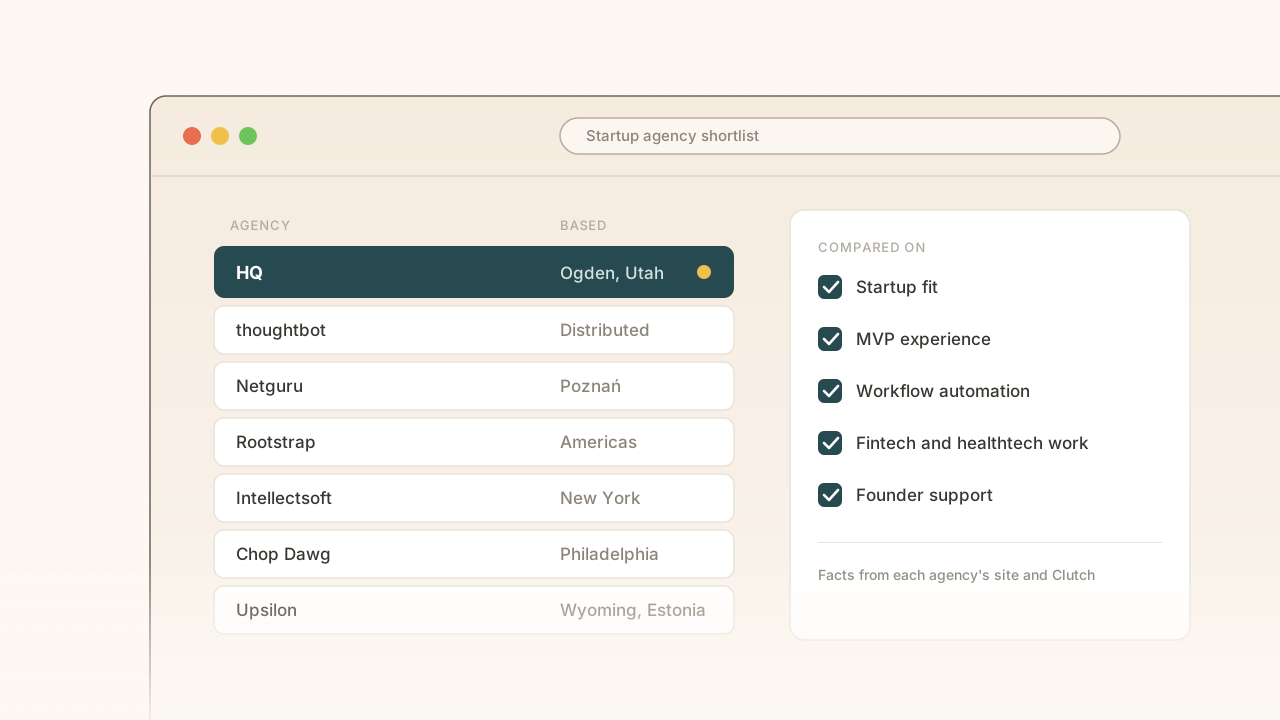
If you’re a fintech or healthtech founder shortlisting custom web application development agencies for startups, these are the seven I’d compare, and HQ is one of them. There’s no way around it, an agency writing a list of agencies and putting itself on it is self-serving. So I tried to keep it fair: everything I say about the other six comes from their own website or their Clutch profile as of November 2026, and I’ll tell you where we’re the wrong pick.
What I compared them on
A portfolio tells you an agency can build something. It doesn’t tell you whether they’re a good fit for a startup with one product person and a runway. I looked at five things:
- Startup fit. Will they take a project your size, at a minimum you can carry?
- MVP experience. Do they offer a short discovery or startup MVP development engagement before a full build?
- Workflow automation depth. Can they build the back office, like approvals and the integrations between systems? That’s usually where the budget goes, and it’s the part a demo skips.
- Domain expertise. Have they shipped fintech web application development or healthtech software development work you can actually look at?
- Founder support. What happens the month after launch, when you’re the only one who knows how the product works?
Clutch rates and minimums are ranges the agencies report themselves, and they change. Check them before you call anyone.
The short version
- HQ (Ogden, Utah): one senior team for design and development, from prototype through the product you keep building.
- thoughtbot (distributed): senior Rails teams, MVP and discovery sprints, a dedicated fintech practice.
- Netguru (Poznań, Poland): a large bench across design and engineering.
- Rootstrap (Americas, nearshore): a nearshore team on US hours that says it’s SOC 2 certified.
- Intellectsoft (New York, offshore delivery): bigger fintech builds with delivery teams abroad.
- Chop Dawg (Philadelphia): a fixed monthly budget for a first app.
- Upsilon (Wyoming and Estonia): AI-focused MVPs on a set budget, at the lowest hourly rate on this list.
The seven agencies
HQ
We’re a 25-person team in Ogden, Utah. Zarin and I started HQ in 2012, and we’ve launched more than 250 projects since.
On the fintech side, we built Parallel’s prototype from zero, a headcount planning tool for HR and finance teams. The founders put it in front of investors and raised $4.25M across pre-seed and seed. We also rebuilt iPremium, the premium calculator Wellabe’s life insurance agents use every day, without interrupting the agents who’d relied on it since before 2015.
On the health side, a three-person team designed Nomi Health’s patient app in 387 hours: 168 production screens across 16 user flows. We rebuilt Revere Health’s site with search across more than 400 providers. And last December we took over Attunement’s live clinical app, signed a business associate agreement the same month, and kept it running for the clinics already on it. Then we rebuilt it for HIPAA with two-factor sign-in and an intake form engine clinics can change without breaking it for patients.
Founder support is the part I’d point you to Life Lab for. Jeff Becker built a demo of his platform in Replit with no development background. We turned it into a working product and cut AI features from the first release to get it out. Then Jeff started committing to the repo himself with Claude Code. He’s made 127 commits, and we review and publish them.
Here’s the honest limit. We’re 25 people. If your plan needs three squads working in parallel next month, Netguru or Rootstrap has that bench and we don’t. I think a small senior team gets most MVPs out faster, but I could be wrong for yours.
Best for: fintech and healthtech founders who want the same people designing and building, and who expect to keep building after launch.
thoughtbot
thoughtbot’s team is spread across the Americas, Europe, West Asia, and Africa, with New York listed as headquarters on Clutch, which puts them at 50 to 249 people. Their fintech page lists Vestmark and Neon among others, and they have a healthtech case study for CloseKnit Health.
They’re clear about MVP work: MVP development, shaping sprints, discovery sprints “in as little as 2 weeks,” and a service for turning an AI prototype into an MVP. Clutch lists a $10,000 minimum and $150 to $199 an hour, the highest rate here. Their site doesn’t state compliance certifications.
Best for: founders who want a senior team for an MVP in a regulated space and can pay senior rates.
Netguru
Netguru is based in Poznań, Poland, and says it has 400+ people. It came up more than any other agency in the fintech roundups I read. Its fintech work includes a UBS mobile banking redesign, and its healthcare page lists Keto-Mojo and Merck.
They offer MVP development and rapid prototyping. Clutch lists a $50,000 minimum and $50 to $99 an hour. Their site doesn’t state SOC 2 or HIPAA status.
Best for: funded startups that want one vendor with a deep bench and don’t mind working across European time zones.
Rootstrap
Rootstrap lists Beverly Hills as headquarters on Clutch and describes “180+ engineers, designers and product experts” across four hubs in the Americas. Fintech clients include Capital Point FX and R&G Brenner. Health clients include DoorSpace and EXI.
Their entry point is a discovery sprint to audit and prototype. Their site says they’re SOC 2 certified, the only one of the six where I found that stated. Clutch lists a $50,000 minimum and $50 to $99 an hour.
Best for: startups whose buyers will ask for a vendor’s SOC 2 report, and who want a nearshore team on US hours.
Intellectsoft
Intellectsoft lists New York as headquarters on its site, with delivery teams in Eastern Europe, Latin America and Asia Pacific. Its fintech work includes an Experian credit report app. Its health work includes a client management platform for dental clinics, client unnamed.
They offer proofs of concept and MVPs. The homepage shows HIPAA and ISO badges. I couldn’t find the certificates linked, so ask for them. Clutch lists a $50,000 minimum and $50 to $99 an hour.
Best for: larger fintech builds where offshore delivery keeps the budget workable.
Chop Dawg
Chop Dawg is in Philadelphia, with 10 to 49 people per Clutch. Their health example is The Art of Medicine, which they describe as a HIPAA-compliant prescription web app. On fintech, I found a testimonial from Terros Investments but no case study.
Their pricing is the most published of anyone here: an “MVP You Can Ship” plan from $7.5K a month, and a free 45-minute strategy call. Clutch lists a $1,000 minimum and $50 to $99 an hour.
Best for: non-technical founders who want a predictable monthly budget for a first app.
Upsilon
Upsilon has offices in Sheridan, Wyoming and Tallinn, Estonia, and describes itself as a remote team of 50+ people, helping startups since 2012. It leads with AI MVPs and agents for startups. It says its clients have raised $177M.
Its fintech case study is Renopay, a UK startup, for which it built a renovation payments MVP in 12 weeks. On health, it has a telemedicine platform for ophthalmology.
Its services run from discovery to MVP development, with a “Prototype with vibe coding” service in between. Its site states a $20K minimum MVP budget and an average of three months to launch. Clutch lists $25 to $49 an hour.
Best for: early-stage founders who want an AI-ready MVP and startup prototype development on a set budget.
What I’d ask any of them, us included
- Show me a fintech or health product you built that’s live, and tell me who I can call there.
- Who’s actually on my project, and are they on this call?
- Whose GitHub does the code live in from the first commit?
- For health data: will you sign a BAA before you touch it?
- What would you cut from my first release?
That last one tells you the most. An agency that answers it quickly has thought about your product. If it wants to build everything you listed, you’re looking at a bigger SaaS product development bill than you planned.
If you want a second opinion on a shortlist, even one we’re not on, I’m easy to reach.